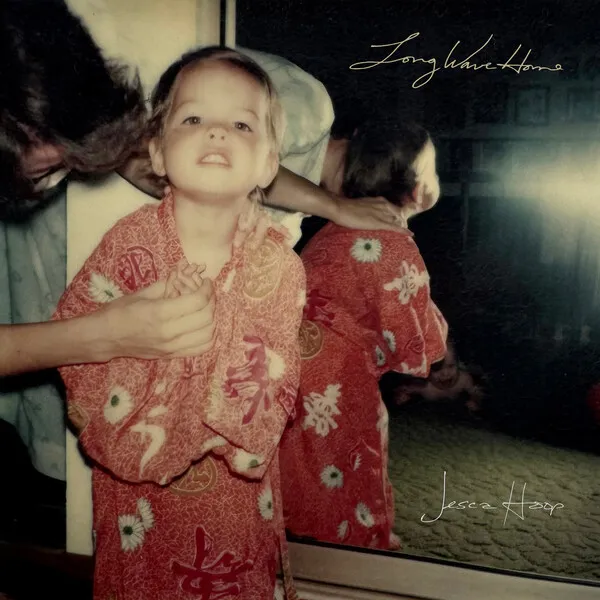
What could possibly possess someone with a solid name like ‘Jessica’ go by ‘Jesca’? I suppose there are a lot of potential causes, sort of like how there are so many causes for Jesca Hoop’s emotional overload on her new album, entitled Long Wave Home.
Much of the album’s planning stems from Hoop taking on a firsthand role as sole producer, for the first time in her career. Its mix of olde folk and modern day eclecticisms – which is what one tends to expect amid the lack of genuine expectations of a Jesca Hoop album – is spiritualised by Jesca’s keeping in touch with the world during its recording; riding around England with no fixed address, taking swims etc. Hoop sounds as though she’s trotting through centuries-old England like never before, agrarian like Fairport Convention.
She has noted, in the past, that she is seldom set on a particular musical language. I, personally, know her as a folk singer-songwriter, one with her own special story to tell, and Long Wave Home is a folk record, but the album imposes eclecticism onto a simple frame. It is folk, but the style of folk changes, the tone ranges from melancholic to quirky to humorous, the rhythms range from melancholic to quirky to humorous, and instrumental embellishments produce interpolations of other styles, including film score and chamber jazz.
Adam embodies much of what I’ve mentioned. Through its natural syncopations, the album opener certainly demonstrates Jesca’s keeping in touch with the world. It is folk with a jazzy, naturalistic bump in each step; an arhythmic journey through England, captured superbly by a Californian, if you pardon the unintended condescension.
What really maximalises the album is Jesca Hoop’s subversion of her own intended narrative. Primarily, Long Wave Home is about person-to-person connections; growths and abandonments in relationships, particularly influenced with those who Jesca lost last year. But the album is also very political. It isn’t one for the “keep politics out of music” crowd, as in, politics is so deeply rooted in what makes us human – especially in 2026 – that its involvement came natural to Jesca’s songs of love and estrangement. This is either insight into how political one’s dissertation on love can be, or how introspective one’s political paper can be. With that in mind, and with Jesca’s musical eclecticism in mind, Long Wave Home quantifies what makes her so different from your average singer-songwriter.
So much is packed into each song that I feel I should just go over them one-by-one, excluding Adam, which I’ve already touched on.
Now the Ash is about seeing signs, separating poison and sugar, anticipating betrayal in one way or another, whether from the people or the gods. Folk’s constant routing through the natural world is dictated by tuned percussions and tree branch basslines that secretly melodise.
Designer Citizen, oh boy, is one of Jesca’s most important, even if it doesn’t dive as deeply into its subject as it could. She remains playful in the MAGA era – chanty, surefooted and refractory – over satire on what her country as done to her and others. In a world where everyone and everything is a Dior bag, an expensive commodity, en vogue with fleeting relevance, all is surrealistically linked to the stupid shit we wish it wasn’t – “I woke up to Elon’s hands all on my tweet cred / shadow-banned for reading Ozturk’s op-ed”.
Big Storm is played-down Pulp Fiction surf rock – something for Uma to dance or overdose to – dreamily produced, replacing conventional rock instrumentation with impeding bass, tuned percussions, and perky vocalisations that leave a mark with their humour. Its lyrics and pacing announce a fast departure, in an attempt to reclaim some freedom.
Love Is Salvation is one of Jesca’s more Greenwich-y ditties; there’s still time for a ‘come gather ‘round, people’ folk song, now enhanced by her off-kilter. This here throwback ends with “fuck ‘em all” and “get to fuck”, which Dylan rarely said unless it was 1979 and he was talking about KISS. A broken relationship destroys your home, a new one builds one. A broken relationship destroys your home, a new one builds one. Rinse and repeat.
Caravan explores a reliance on intimacy, desperately sourcing intimacy, whatever kind, from one’s connections. The acoustic instrumentation is Neil Young-reminiscent, like Old Man, sneaking with a doomed Americana, full of feeling even in its moments of callous – very Neil but also very medieval. The song features some of Jesca’s best falsettos and most humourful vocalisations – she has as much time for a cheeky “doo-doo” (which is not a euphemism) as she does a ‘come gather ‘round, people’.
Playground contains one of the album’s most notable quotables – “if rubble is playground”. It soon becomes apparent that she is singing about the children of Gaza, over tension-inducing percussion, like an erratic clock; inciter of dark thoughts where sympathy and action are required.
Signal to Noise is Jesca’s best combination of rugose musicianship and sentimentality. The song is played on loosened banjo strings that sound like the cries of a dying swamp. Jesca is contemplative, up through the night, thinking about revolution alongside a chorus that carefully hops, and heart-sinking harmonies of passionate chord choices and vocals that yearn despite their quietude.
Viv Over Drink contains weird, juggling acoustic guitar lines, and a thesis of “I choose friendship”, occupied by the warmth of brass – you ever been hugged by trumpets? Hell, the whole thing’s a hug.
The title track’s theme is very “it’s been done”, but still vital. The observation of technology making us feel more estranged from one another, unfortunately, continues to have merit, as social media has us wondering who and what is actually real whilst we’re forced to sidestep the cruelties many feel they can get away with through the internet. The theme continues to have merit as we rely on instant messaging to maintain relationships – we’re not really together. Hoop uses the moment to end on another contemplative note, a little bittersweet, as reeds and woodwinds appear like breeze through open windows.
Jesca Hoop is a continual treat of a performer; an open book shrouded in the mysterious whimsy of nature. She uses her latest album, which really is one of her very best, to realise a self-reflective understanding, treating music-making as therapy. Long Wave Home is filled with contemplation, anxiety and lovey triumph; something nice, and potentially guiding, as the world around us refuses to be.
Best tracks – Designer Citizen – Signal to Noise – Viv Over Drink.
Rating – 8 out of 10
